As a medical professional or healthcare facility manager, you know ultrasound machines are indispensable medical equipment today. You also know of the innumerable options on the market, ranging from cart-based to portable handheld ultrasound machines.
What you might not be sure about is how much an ultrasound machine costs today.
Our thorough research revealed that ultrasound machine costs range from $3,199 for a portable point-of-care scanner to $120,000+ for high-tier cart-based systems.
This article will give you a detailed answer to the question, "How much does an ultrasound machine cost," while reviewing 12 examples.
Let's start by underlining the factors that set the cost of medical ultrasound equipment.
Point-of-care scanner costs average around $3,199 to $6,000.
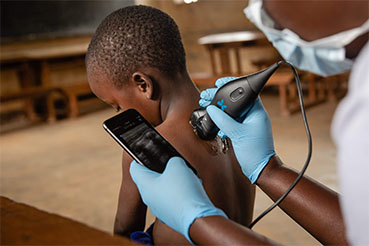
Although they are smaller and best suited for less demanding healthcare settings, point-of-care ultrasound scanners are proving their reliability as viable emergency scanning solutions with similar accuracy to their cart-based counterparts.
Our 7 examples will show you that portable point-of-care ultrasound scanners are affordable ultrasound machine options with high-quality imaging. Besides, most of them have multiple imaging modes and are extremely user-friendly.


Versatile Usage/ Best Overall
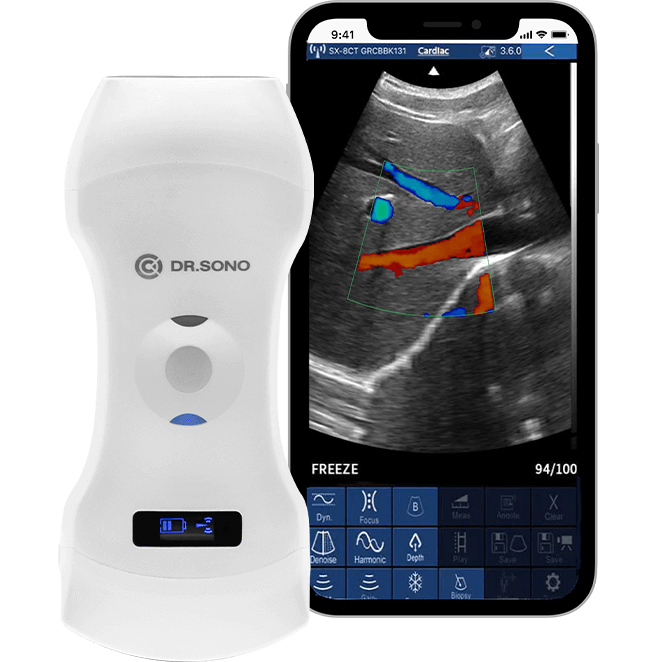
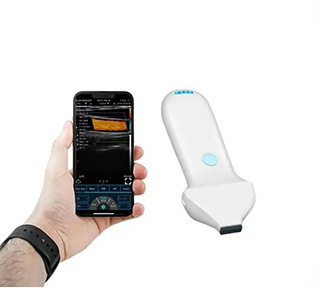
The handheld DRSONO Tri-scan Max is one of the most affordable portable ultrasound machines you'll find in the market. You could say the scanner is a cheap option with great value if you consider its great features.
For example, you don't need a wired connection to charge this machine. You simply place it on a wireless charger and enjoy 5 hours of scanning when the battery is fully charged.
Also, you only turn the DRSONO Tri-scan probe from one end to the other to swap between the three scanning modes, linear, convex, and phased.
And the imaging?
Beyond HD! That's thanks to the 192 piezoelectric elements and the latest AI tools.
Also, you have access to an endless list of exam types, including general imaging, cardiac, breast, thyroid, vascular, and OB/GYN. Plus, you have free access to the application, not to mention the interactive image and note-sharing with colleagues straight from your gadget.
With no wires and cumbersome trolleys, the Clarius PAL HD3 ultrasound creates an interactive scanning experience between provider and patient.
Expect superior image quality with the HD3 phased array probe in diverse scanning areas, including vascular, cardiac, abdomen, and prostate, reaching up to a 40cm depth. The portable handheld scanner also provides FAST and transcranial imaging.
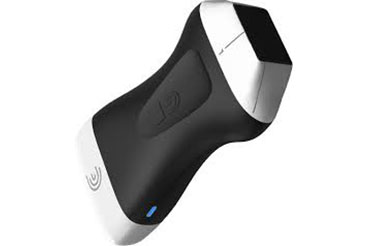
The Butterly iQ+ scanner offers a range of imaging options in equally vast application settings. They include applications in emergency medicine, anesthesiology, cardiology, and MSK.
This small probe possesses advanced tools to guide complex diagnostic procedures with biplane views and needle visualization on your gadget screen.
Moreover, the Teleguidance™ tool allows you to collaborate with colleagues by sharing images and video clips remotely.
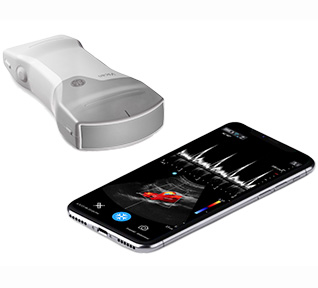
Vscan Air™ CL is one of GE Healthcare's Smart ultrasound machines, specially created for the point-of-care setting.
With its linear and curved transducer modes, you can perform quality imaging in a range of applications, including abdominal, vascular, lungs, MSK, and obstetrics.
Although Vscan Air's battery charge is short-lived and lasts only 50 minutes, its other features make up for it. In fact, a study rated Vscan Air as the best point-of-care ultrasound machine in ease of use.
The patented SignalMax™ technology produces quality images with high-intensity signal processing. By doing that, the Vscan Air proves to the medical world that you don't have to sacrifice quality when you opt for a handheld ultrasound machine.
Philips Lumify L12-4 is the renowned manufacturer's version of a handheld portable ultrasound machine.
The linear-probing ultrasound scanner is made for shallow imaging of the soft, vascular, musculoskeletal, superficial, and lung tissues. This makes it a great option for private practice offices and hospital emergency rooms.
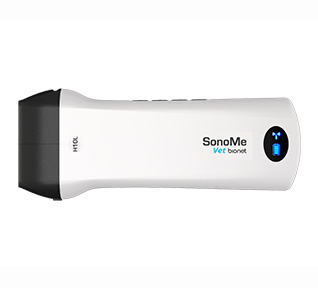
The SonoMe H10L is an easy-to-use handheld ultrasound scanner that you simply connect to your gadget and attend to your patients without any activation or subscription fee.
Perfect as a point-of-care ultrasound scanner, enhancing your clinic's workflow and patient satisfaction.
Here's your quick summary comparison of the best ultrasound machine for pregnancy.

Most cart-based ultrasound machines are pricey, with costs ranging between $10,000-$120,000+.
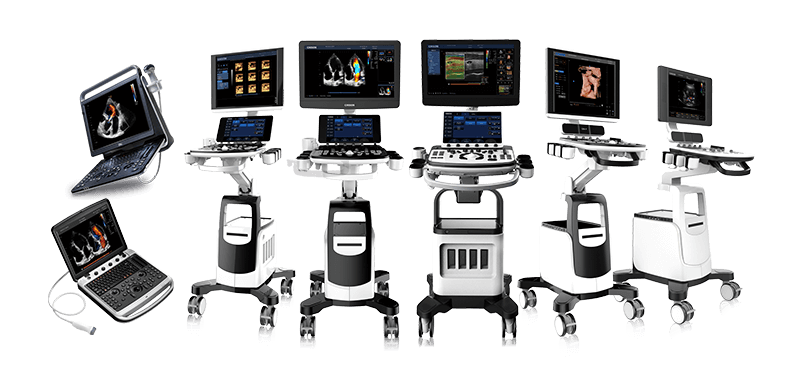
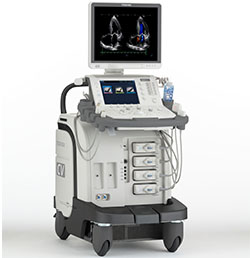
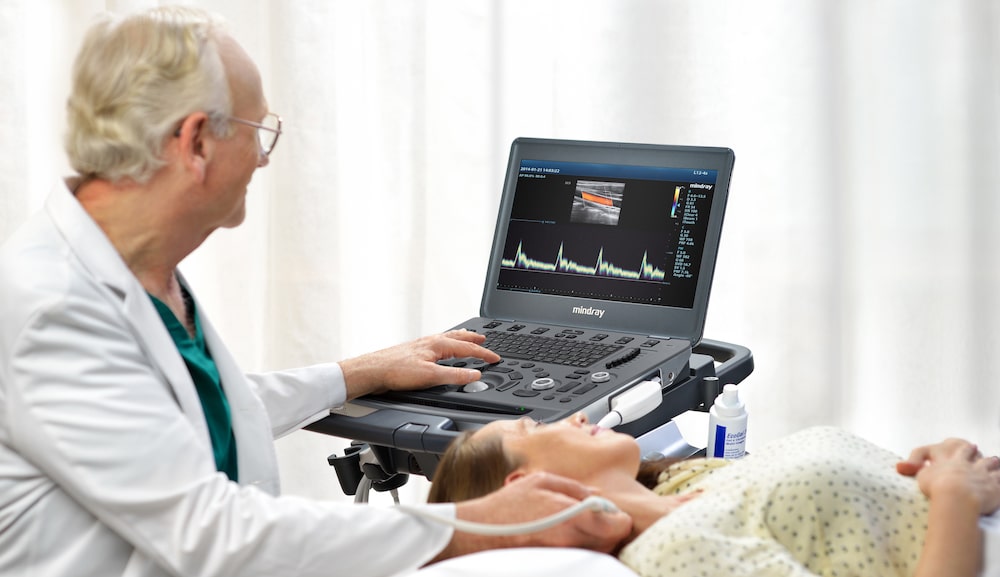
Cart-based ultrasound machines are imaging systems that require a cart to move around from one POC setting to another.
Their need a cart because they have large consoles where you find the computer unit for image processing and display on a monitor.
These large ultrasound machines also house the traducer holder or holders for models that offer multiple probe options. There's also the control panel for feeding instructions to the ultrasound during imaging.
Often, the ultrasound cart houses a built-in printer, traducer connection ports, and storage compartments for other accessories.
Manufacturers have improved the imaging technology of these conventional cart-based ultrasound machines over the years.
As a result, they have cutting-edge efficiency features that give them multiple benefits, including greater effectiveness over their counterpart point-of-care systems when used in specialized imaging.
Because of all these factors, it is obvious that cart-based ultrasound machines are pricey. But their performance in imaging is always worth the price.


Best Automated Imaging Tools & Team Collaboration
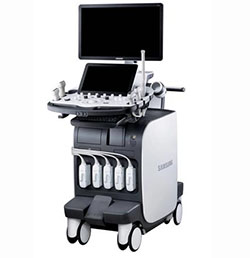
Samsung RS85 Prestige is true to the household manufacturer name with its autocalibration feature that supports simple diagnostics and complex biopsy procedures.
Other features like S-Tracking increase accuracy during interventional procedures by providing a simulated needle path and target mark within the live ultrasound image.
Samsung RS85 Prestige uses the latest IT to ensure cybersecurity and promote ultrasound system remote control, real-time image sharing, and professional discussions.
If you are looking for an ultrasound machine option with high image quality and a range of automated and AI-aided tools, Philips EPIQ Elite should be your choice. This brand also comes with advanced imaging modalities for different applications.
Features such as the MicroFlow imaging technology, AutoScan image adjustment automation, and xMatrix transducer technology deliver unmatched image quality with the ease of reduced button clicks.
Besides, you can rely on its user-friendly ergonomics, like the high-resolution monitor, touch screen panel, and adjustable design for the most comfortable imaging experience.
The GE LOGIQ™ E10 is arguably the most popular cart-based ultrasound machine on the market today. You need to send a price quote to the manufacturer for a personalized price offer or warranty and product return details.
However, any cost range for the GE LOGIQ E10 returns great value for your money, considering its advanced features, like precision imaging and AI tools.
Thanks to these features, you have enhanced workflow in busy healthcare environments, quick and precise imaging, and high-resolution images for accurate diagnoses in a vast range of patient categories.
Besides, you can use this ultrasound for multiple imaging needs, including general imaging, small body parts, cardiac, vascular, obstetrics/gynecology, and a lot more.
Never has an ultrasound machine been so cost-effective while providing a super-wide range of advanced technology features.
With its price range, the Mindray DC-40 ultrasound machine delivers the highest level of image quality with iClear speckle reduction, iBeam special compounding, and Phase Shift Harmonic scanning.
The model's vast range of applications provides answers for your imaging needs and all patient categories.
Canon Aplio 500 Platinum Series provides a complete set of advanced tools with the highest level of diagnostic imaging, including MicroPure™. This tool marks possible malignant calcifications as white spots, while the Biopsy Enhancement Auto Mode (BEAM) guides needles in biopsy procedures.
The machine's FlyThru tool produces 3D images of masses and lesions in ducts and cavities, similar to endoscopy technology.
Here's your quick summary comparison of the best ultrasound machine for pregnancy.

Several factors determine how much you pay for an ultrasound machine. We discuss below the most significant ones.
An ultrasound machine system type refers to the medical service or context it's made for. Ultrasound system types fall into three categories:
Within each category, prices can vary depending on whether the machine is entry-level (low-tier), mid-range (mid-tier), or high-tier (premium).
Point-of-care Ultrasound Machines:
Point-of-care ultrasound (POCUS) machines are the most cost-effective of the three types. You can buy one for around $3,199.
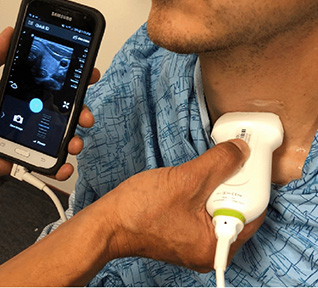
These portable machines allow medics to perform diagnostic ultrasounds at the patient's bedside. You will also likely find a point-of-care ultrasound machine at a doctor's office, ambulance, or hospital emergency room.
Despite their size, they are fast and accurate diagnostic tools. Check our 7 examples of POCUS machines later in the article.
Shared Service Ultrasound Machines:
Price ranges for shared-service ultrasound machines vary from around $10,000 for entry-level systems designated for simple imaging tests to about $40,000 for high-tier ultrasound machines for complex procedures.
This category includes ultrasound machines designed for multiple hands and diverse healthcare settings.
The machines can withstand the busy routines in hospitals, imaging centers, and multi-specialty clinics. They are used across specialties like radiology, OB/GYN, cardiac, and vascular imaging.
Specialized Ultrasound Machines:
Specialized ultrasound machines are high-investment machines worth thousands of dollars, >$40,000 to $120,000+.
These are ultrasound machines for specialized practice. They have customized software and hardware to produce the highest-quality ultrasound images.
You'll find specialized ultrasound machines in specialized clinics and as reserved medical equipment in designated hospital sections such as cardiology, oncology, obstetrics/gynecology, and urology.
Our list of cart-based ultrasound machines gives you examples of both shared services and specialized ultrasound machines.
Some ultrasound machine brands and models have been on the market for many years and have become popular. Of course, that also comes with customer credibility in the model. Popular ultrasound machine brands will cost more than newer models trying to navigate the market dynamics to make a name for themselves.
Market research by GlobalData suggests that popular ultrasound machine brands include GE Healthcare, Siemens Healthineers AG, Philips Healthcare, and Canon Medical Systems Corp in that order.
In fact, GE and Philips ultrasound machines are among those with fatter price tags on our lists of both cart-based and portable handheld ultrasound machines.
Newer brands and models will also cost more if they have the latest Smart features, such as 4D imaging, TEE probes, Smart Apps, AI, and Automation features. Others have exceptional features such as remote control and real-time image sharing.
It is indisputable that a new ultrasound machine will cost you more than a used or refurbished one.
New ultrasound machines arrive to the buyer straight from the manufacturer or distributor. You buy these machines at the current market price, with the manufacturer-set warranty cover.
Market indicators suggest that new cart-based ultrasound machines will go for around $10-000-$1200,000+ depending on the brand and model.
Refurbished ultrasound machines have undergone a complete makeover by professional technicians. That brings their performance up to date with manufacturer standards and gives them a deserved facelift.
The cost of a refurbished ultrasound machine will depend on how much work goes into renovating the machine. According to Greenbook, the cost of refurbished ultrasound equipment is usually 50%-60% lower than new ones.
Used ultrasound machines are passed from a first buyer to a second buyer as they are. That makes them the cheapest option of the three categories. However, it's important to have the machine's condition evaluated to make sure you are buying it for what it's worth.
It is important to mention the Demo ultrasound machines. These ultrasound machines have not been in the hands of a customer. They are used for trade fairs and exhibitions or testing and training purposes and are almost new.
Their quality and cost lie between the new and refurbished machine categories. That means you can buy a demo ultrasound machine for 30%-40% less than new machines.
Also, note that POC handheld ultrasound machines have a shorter lifespan and are usually sold in new condition.
Ultrasound machines have to be moved from one healthcare setting to another from time to time. This can be cumbersome if you have a large machine, and that also means a trolley as an efficiency accessory.
Larger cart-based ultrasound equipment has more invested in the manufacturing process than the portable options.
For the same reason, smaller handheld ultrasound machines that use simple tabletop stands and weightless pocket versions are less costly than larger cart-dependent ultrasound machines.
To give you an example, the most expensive cart-based ultrasound machine on our list is listed for over $120,000. The most expensive of our portable handheld ultrasound machine examples goes for $6,000.
Other factors that define the cost of ultrasound machines include:
I'll tell you more about the cost differences between cart-based and point-of-care ultrasound machines in the designated sections later.
First though, here's a pro tip on how to get value for your money when buying an ultrasound machine on a budget.
You can only buy an ultrasound machine worth the money you have. But that should never equate to getting the least value for your money.
Here's a tip you can use to ensure you get the best value for the money you have:
Opt to buy a refurbished machine of a high-tier if you are looking for a new one from the mid-tier. For example, if you are looking for a new mid-tier ultrasound machine with a $45,000 budget, buy a refurbished high-tier ultrasound machine for the same amount.
This is a way of getting a more updated ultrasound machine model for the price of a lower model.
Of course, you'll need extensive research to ensure you get what you need while remaining within your budget. It is also a way of owning the ultrasound you need now while you plan to upgrade in the future.
Once your ultrasound machine is in your office or at the healthcare facility or hospital, there are still additional costs you might incur. These include:
Delivery and Setup Costs
Delivery costs cater to shipping and can be lower or higher depending on whether it is road or air transport. These costs vary from one manufacturer/supplier to the other.
You will also incur setup costs if a technician visits your healthcare facility to configure your new ultrasound machine to online manufacturer resources and your healthcare data system.
These costs can run up to $2,000 on the higher end.
Before purchasing an ultrasound machine, inquire with the supplier or manufacturer about additional delivery and setup costs so that you know what to expect.
Application Training
Training your personnel in new ultrasound machine applications is a worthy investment. This can be in-person or remote training through access to online material or trainers.
Application training costs can range between $700-$3,000, depending on the mode of training.
Maintenance and Warranty
We always think warranties are free. Often, however, they are part of the purchasing cost, and if not, they can become additional costs after purchasing equipment.
Some manufacturers will offer maintenance/service contracts, labor, and extended warranties at an additional cost, usually 5 years.
Service contracts can be parts-only (not labor), time and material (overall yearly preventative maintenance), or full service (all servicing and maintenance). Costs for these options usually reach 10-15% of the ultrasound machine's purchasing price.
So, if your new ultrasound is worth $60,000, maintenance and warranty costs may go up to $6,000-$9,000.
Efficiency Accessories
Ultrasound machines require some efficiency accessories needed to optimize their usage. These accessories come at an extra cost and include:
The cost of these accessories will vary depending on quality and supplier. The price of consumables like ultrasound gel and printing papers will also depend on how fast you restock.
And now, with all the details on the factors affecting ultrasound machine price in mind, we can proceed to the next step. Let's find out exactly how much cart-based and point-of-care ultrasound machines cost and how their prices compare.
What is the cost of ultrasound machines? It all depends on a range of factors, especially the system type, whether they are low, mid, or high-tier ultrasound machines.
Ultrasound machine cost also varies by model, portability, and condition (used, refurbished, or new).
The examples in this article confirm that high-tier and new ultrasound machines cost more than low/mid-tier and used and refurbished machines.
Besides, cart-based ultrasound machines are large and use more advanced technologies, making them pricier than the portable point-of-care models.