In this section, we have all the features of the best 5 clinical ultrasound machines to help you pick the best one for your clinical setting.

Best for Fast-Paced Clinical Settings
What's better than a portable ultrasound machine that clinicians can use with every patient type in any clinical setting for full-body scanning?ย
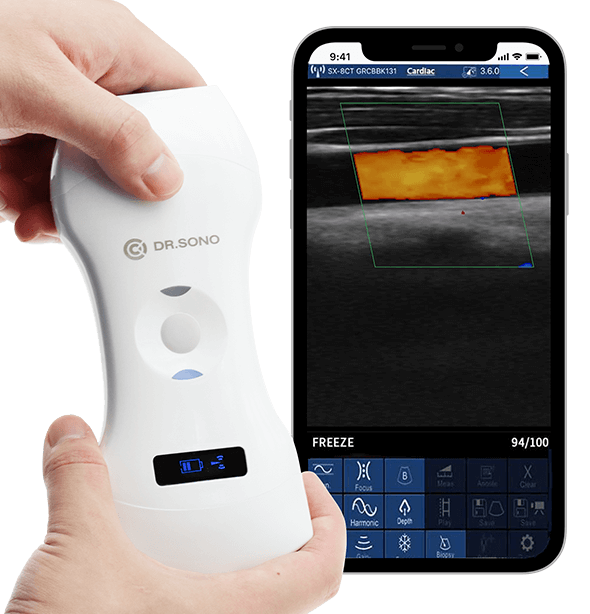
Theย DRSONO Tri-scan Maxย is exactly that option.ย
This handheld ultrasound scanner delivers better-than-HD high-quality imaging in a wide range of applications using 3 different probes on a single device. Plus, it connects wirelessly to your devices in real-time, delivering fast and timely imaging for prompt diagnosis.
So, what makes the Tri-scan Maz stand out?
Here are its best features as a clinical ultrasound scanner:


If you need quick ultrasound scans at the ER on the spot, theย Vscan Airโข SLย transforms cardiac and vascular assessments into crystal clear images for fast diagnosis and first-pass success IV line placements.
The GE dual-probe device is created with both professional and novice users in mind. You can count on it for simple vascular scans or more complex lung and abdominal assessments, among others.
Here's why the Vscan Air SL features on our list of the best ultrasound machine for clinic:
The Clarius PAL HD3 ultrasound delivers the imaging power and clarity of cart-based ultrasound imaging systems in a handheld portable scanner.
With its innovative 8-beamformers and 192 elements, thisย pocket-sized marvel deliversย deep and shallow scans with exceptional clarity, helping you diagnose and treat with confidence in hospitals and every other clinical setting.
Below is what sets the Clarius PAL HD3 aside from other medical ultrasound machines:
Theย Butterfly iQ3ย has all the features needed for ultrasound imaging in busy clinical settings. These include a 3-in-1 transducer, best-in-class image quality, fast data processing, interactive user interface, and user-friendly ergonomics.
The IQ3 empowers medical professionals with the magic of AI-powered ultrasound technology to deliver timely diagnosis and treatment.ย
Let's explore why the iQ3 deserves a spot on our short list of the best portable ultrasound machines for clinic:
The Mindray TE Air Wireless handheld ultrasound machine is a true Point of Care Ultrasound (POCUS) device with exceptional image quality, user-friendly design, and all the convenience of a wireless system.
The wireless probe is highly versatile as it can be paired with iOS and Android devices or be connected to the TE X Ultrasound System. This means clinicians can adapt it to their specific clinical settings to enhance workflow and patient care.
Here are the features that place the TE Air among our top-rated ultrasound machines:
A summary comparing the features of the top 5 clinical ultrasound machines will help you decide on your best fit faster.ย
But before that, let's revisit some key clinical ultrasound details: clinical correlation in ultrasound, applications of clinical ultrasound, and the factors to consider when choosing a clinical ultrasound scanner.
The purpose of clinical ultrasound is to support accurate and timely diagnosis. But ultrasounds don't work in a vacuum. Clinical correlation requires medics to interpret ultrasounds alongside other medical assessments.
In that light, clinical correlation in ultrasound refers to the holistic interpretation of ultrasound results alongside presenting symptoms and other medical reports like physical assessment, lab test results, and the patient's medical history.
The reason medical professionals do clinical correlation in ultrasound is to determine if the findings are clinically relevant or further medical exams are required for a more precise diagnosis.
So, even though an ultrasound image may look abnormal on the scan, that doesn't necessarily mean it is bad news. For example, clinical correlation can help physicians rule out malignancy in a presenting growth and make a favorable diagnosis for a benign case.
Curious how clinical correlation applies to real life? Let's explore some key ways it can impact health care.
As a diagnostic procedure, clinical ultrasound has a core advantage because it does not entail surgical interventions or other invasive procedures.
So, exactly how is ultrasound applied in clinical settings? Let's delve into a few of the common ultrasound applications.
A widespread misconception is that clinical ultrasound imaging is only used with expectant mothers.
Not exact!
When injured or critically ill patients arrive at a hospital's ER, prompt treatment decisions have to be made to save their lives.
Medical professionals can perform emergency ultrasounds, such as FAST, to determine if life-threatening fluid collections exist around vital organs like the heart or abdominal cavity.
Also, a lung ultrasound can help a doctor identify a possible collapsed lung (pneumothorax), a condition caused by air leak between your lungs and the chest wall. In such a case, a tube will be inserted ASAP to remove the trapped air and save the patient's life.
Your heart is your most important muscle.
But how do doctors know that your cardiac muscle is working at its best?
Through an echo!
While not everyone calls it that, a heart scan, cardiac ultrasound, or echocardiogram helps doctors see inside your heart. The small transducer on your chest works like a tiny mic, sending sound waves to your heart to form clear pictures.
With echocardiography, doctors can see:
Pretty amazing, right?
But echocardiography isn't just for diagnostics. Physicians use it to assess treatment efficacy and even guide corrective procedures for defective heart valves.
Awaiting a newborn baby brings joy to expectant moms. Yet many queries on fetal growth and development can also cause worry.ย
Ultrasound for pregnancy proves invaluable here. Mothers and their doctors can safely monitor the baby's development throughout the gestation months.
Pregnancy ultrasounds can reveal:
In gynecology, ultrasounds can help diagnose uterine cysts, fibroids, or other related conditions that impact reproductive health and overall well-being.
Ouch! Pulled a muscle?ย
If you have ever had a bad back or an ankle sprain, you know that such injuries cause pain and are annoying. Clinical ultrasound comes to save the moment.
An MSK ultrasound acts like a detective's magnifying glass for muscle, tendon, and joint issues. It sends sound waves to the hurt area, giving doctors a clear look at the cause of pain. This could be a torn muscle, sprained ligament, inflamed tendons (tendonitis), or inflammation due to fluid buildup.
With the ultrasound results, doctors can:
So, what should you look for in a medical ultrasound machine to perform these and other types of ultrasounds?
If you ask the experts, portable clinical sonography machines are the in-thing right now. But selecting the right one for your clinical setting can be as confusing as reading a doctor's notes.
We've got you. And here are the factors you should consider when choosing a portable ultrasound machine.
Ultrasound image quality is the foundation for accurate diagnosis. Crystal clear images with high resolution will make diagnosing easier and precise.
When choosing a portable ultrasound scanner, research the different models to find the one that delivers the image quality you need for the common clinical applications.
Requesting a demo on the manufacturer's websites can help you make an informed choice.
Portable ultrasound scanners are meant to go with you everywhere. So, when choosing a portable clinical ultrasound scanner, weigh its portability by these factors:
Different specialties require specific device capabilities. But hospital and clinic emergency rooms are open to all patient types.ย
Consider your clinical situation. For example, a fast-paced clinic or hospital may require an ultrasound machine with all three probe types. Instead, a specialized clinic can make do with the type of probe most appropriate for its cases, like a linear-only probe for musculoskeletal cases.
Portable ultrasound machines come with different price tags. Their cost can vary based on factors like the latest technology and software, features, and manufacturer popularity.
Set a budget and compare it to the scanner features and capabilities you need for your clinic or hospital. Think long-term too โ "will this scanner work for its entire estimated lifespan?"
In the busy healthcare facility schedules, portable machines are exposed to consistent handling. As such, portable ultrasound devices that have been drop-tested and have a high waterproof and dustproof rating make a great choice. They can handle the bumps and scrapes of a busy clinical environment.
Also, consider the warranty period, as both standard and extended warranties should point to the manufacturer's rating of the device's durability.ย
Different probes tackle different tasks. So, make sure your chosen machine has probes compatible with the exams you'll be performing.
With this cheat sheet, you are now ready to find the perfect portable clinical ultrasound machine. Check out the summary of the features of the top 5 clinical ultrasound machines.

Medical scanning with sound waves has advanced a lot. It's no longer just for expectant moms, but for numerous clinical purposes to give doctors clear insights for accurate and timely diagnosis.
The top portable clinical ultrasound machines have the best features, like clear, high-resolution images, multiple probe types in a single device, and multiple display modes for diverse specialties and applications.
Looking for a clinical ultrasound machine? What features are most important to you? Share your thoughts and experiences in the comments section below, and let's keep the conversation going!
1. Agyekum, E.A., Ren, Y.-Z., Wang, X., Cranston, S.S., Wang, Y.-G., Wang, J., Akortia, D., Xu, F.-J., Gomashie, L., Zhang, Q., Zhang, D. and Qian, X. (2022).ย Evaluation of Cervical Lymph Node Metastasis in Papillary Thyroid Carcinoma Using Clinical-Ultrasound Radiomic Machine Learning-Based Model. Cancers, [online] 14(21), p.5266.
2. Volkova, N.V., Valamina, I.E., Shvidun, D.V., Rebrieva, A.S. and Sadick, N.S. (2019). Facial rejuvenation using Er:YAG laser equipped with a spatially modulated ablation module:ย A clinical, ultrasound, and histological evaluation.ย Journal of Cosmetic Dermatology, 18(5), pp.1294โ1299.
3. Bachu, V.S., Kedda, J., Suk, I., Green, J.J. and Tyler, B. (2021). High-Intensity Focused Ultrasound:ย A Review of Mechanisms and Clinical Applications.ย Annals of Biomedical Engineering, 49(9), pp.1975โ1991.
4. Vahid Ashkani Chenarlogh, Mostafa Ghelich Oghli, Shabanzadeh, A., Nasim Sirjani, Akhavan, A., Shiri, I., Arabi, H., Morteza Sanei Taheri and Mohammad Kazem Tarzamni (2022).ย Fast and Accurate U-Net Model for Fetal Ultrasound Image Segmentation.ย Ultrasonic Imaging, 44(1), pp.25โ38.
5. Barr, R.G., Huang, P., Luo, Y., Xie, X., Zheng, R., Yan, K., Jing, X., Luo, Y., Xu, H., Fei, X. and Jeong Min Lee (2020). Contrast-enhanced ultrasound imaging of the liver: ย review of the clinical evidence for SonoVue and Sonazoid. Abdominal Radiology, 45(11), pp.3779โ3788.
6.ย Mongodi, S., De Luca, D., Colombo, A., Stella, A., Santangelo, E., Corradi, F., Gargani, L., Rovida, S., Volpicelli, G., Bouhemad, B. and Mojoli, F. (2021).ย Quantitative Lung Ultrasound: Technical Aspects and Clinical Applications. Anesthesiology, 134(6), pp.949โ965.